
Standardization Is the Real Advantage of Aluminum Formwork
01 The hidden power of repetition
Repetition is the quiet economic engine of high-rise construction. When a typical floor repeats twenty, thirty or forty times, every improvement made once is banked on every floor that follows. A formwork system designed for that repetition compounds four advantages:
▪ A learning curve — crews install faster each cycle as the sequence becomes familiar.
▪ Predictable installation — the same panels in the same positions remove guesswork.
▪ Consistent quality — identical assemblies produce identical concrete, floor after floor.
▪ Fewer site decisions — standardized parts remove the on-site improvisation that creates errors.
Published studies of repetitive-floor construction have reported slab cycles of approximately twenty-one days using conventional methods compared with around ten days using a planned aluminum formwork system (Rivankar & Chordiya, 2017). Actual cycle times depend on project geometry, crew experience, logistics and site management.
The underlying advantage is not simply faster work; it is reduced variation from one cycle to the next.
Conventional site-cut systems generally capture less of this repetition because more fitting, adjustment and reconstruction are required between cycles.
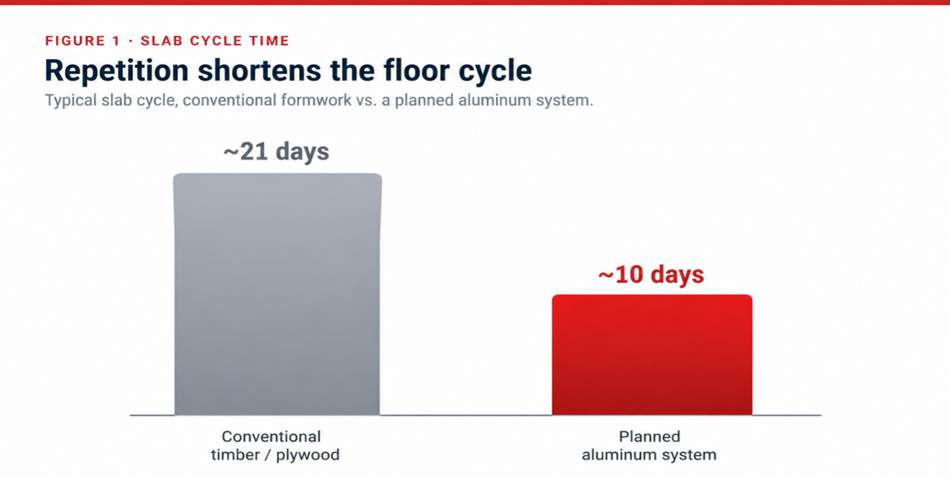
Figure 1 — Repetition shortens the floor cycle: conventional formwork against a planned aluminum system.
02 Standardization starts with design
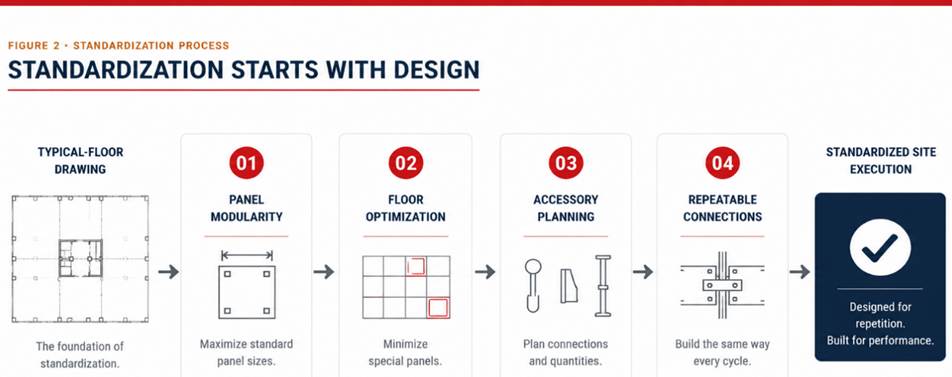
A standardized site begins on the engineer's screen. The typical floor is modulated around a defined library of panel sizes, with special panels reserved for conditions that genuinely cannot be standardized. Accessories and connection details are then planned around the same layout.
The objective is to maximize the proportion of the system that can repeat unchanged from one floor to the next. The higher that ratio, the more the project behaves like a controlled production process rather than a sequence of individual builds.
03 What the factory makes possible
Standardization on paper is a drawing, while standardization in production is a capability.
.▪ Mold utilization — a deep mold library (ELPHA maintains 5,000+ mold sets) means most standard panels are produced from existing tooling, avoiding new-tool lead time.
▪ Production efficiency — ELPHA's 40+ automated production lines support repeatable fabrication at volume, while its extrusion capacity provides the production depth required for large-scale projects.
▪ Quality consistency — automated fabrication reduces the panel-to-panel variation that would otherwise defeat standardization on site.
▪ Replacement availability — because parts are standardized and tooled, a damaged panel is replaced with an identical unit rather than a custom repair.
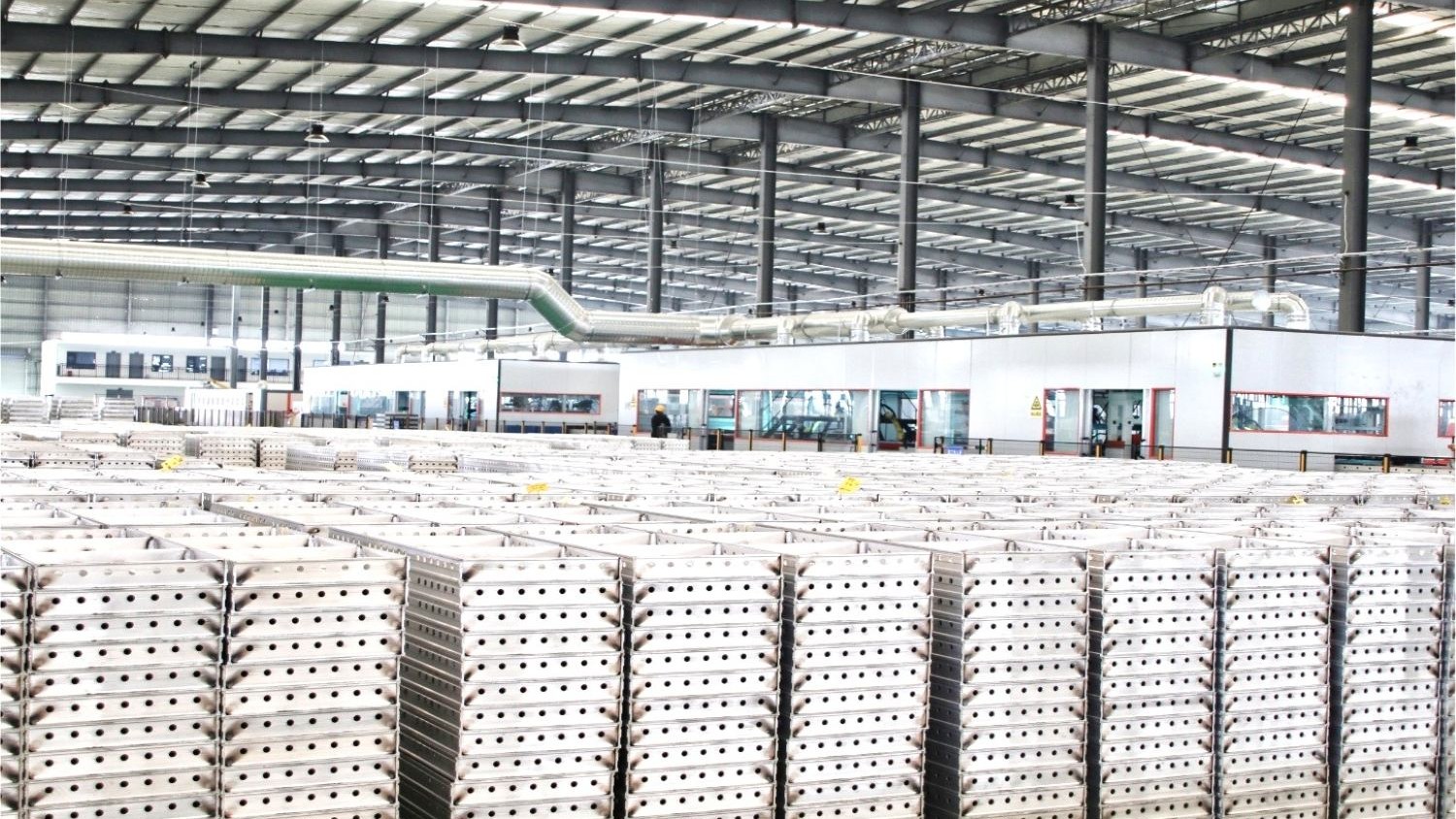
Figure 3 — Standardized aluminum formwork panels produced in repeatable batches. (Source: ELPHA Formwork, 2026.)
04 What the site gains
On site, standardization reduces the number of decisions that must be made repeatedly. Crews encounter familiar panels, positions and connection methods from one cycle to the next, reducing fitting, rework and coordination requirements.
The economic consequence extends beyond installation speed. A formwork error can affect the pour sequence, labor utilization and the next scheduled cycle. Standardization reduces opportunities for those errors by resolving more decisions during design rather than on site.
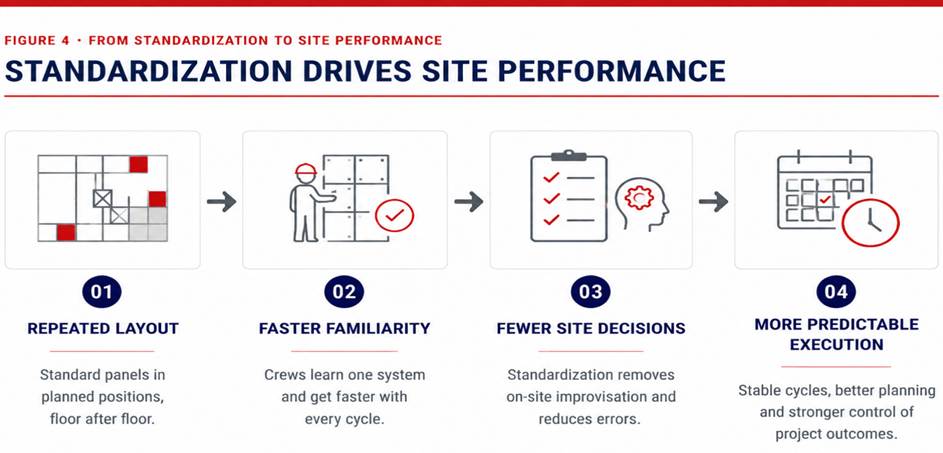
Figure 4 — How standardized repetition translates into more predictable site execution. (Source: ELPHA engineering framework, 2026.)
05 Standardization is engineered, not assembled
The panel is the visible product. The standardized process is the real one. A standardized system is not simply a collection of identical panels. It is a designed construction methodology: a typical floor deliberately modulated for repetition, a connection system chosen for consistency, an accessory plan tied to the layout, and a factory capable of produce and replace every part to the same specification.
At ELPHA, standardization begins before production with drawing review and system modulation, followed by controlled manufacturing, QC and mock-up assembly before shipment. These processes are supported by ELPHA's integrated manufacturing operations and the XMXYG supply chain.
Next step
Planning an overseas project? Send your drawings and target timeline. We will come back with a system layout, a reuse plan, and a clear delivered-cost breakdown.

06 Sources and references
Rivankar, H., & Chordiya, A. (2017). Aluminium Formwork Technology. International Journal of Advanced Research in Science, Engineering and Technology, 4(4), 3720–3726. ISSN 2350-0328.
Henan ELPHA Formwork Co., Ltd. (2026). Internal engineering specifications, mold-set and production-line registers, modulation and quality-control records, and verified project records. Unpublished company records.
Note: ELPHA manufacturing figures, including mold inventory, automated production lines and extrusion capacity, are company-reported operating data and are not independently audited. Published cycle-time comparisons are historical reference points; actual project performance varies according to system design, project geometry, crew experience, logistics and site management.