
Beyond Annual Capacity
01 Why the annual number misleads
Every formwork supplier leads with the same figures — square meters per year, tons of extrusion per year, factory floor area. These metrics are easy to present and compare, but they provide only a partial picture of a manufacturer’s actual capability. An annual capacity figure describes the theoretical throughput of a fully-booked factory. It says nothing about whether that factory can produce your system, to your tolerance, on your schedule, and support the project after shipment.
A large annual capacity can still coexist with limited tooling, insufficient engineering resources, or weak export execution. The number answers one question — How much can the factory produce? It does not answer the more important project-level question — Can it reliably deliver your system?
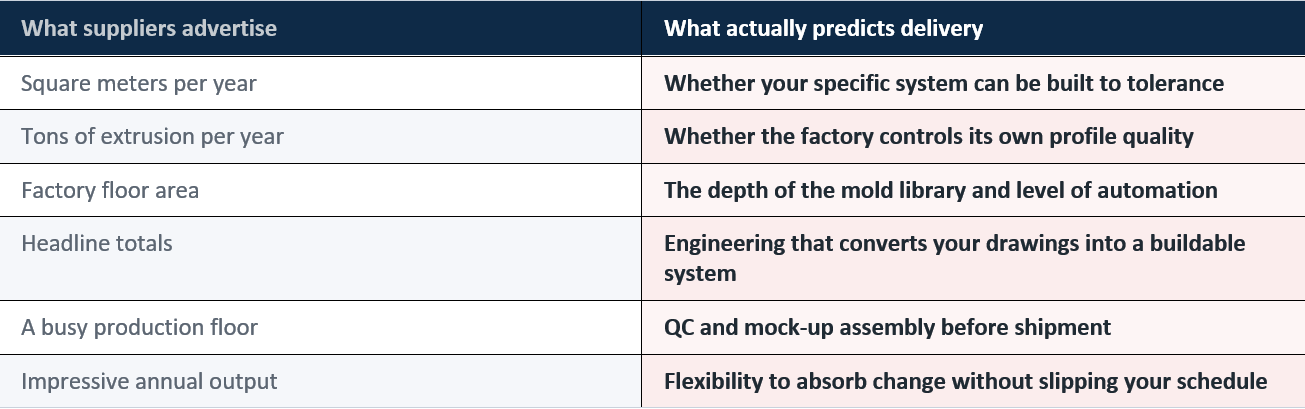
Headline capacity shows scale. Manufacturing capability determines whether that scale translates into reliable project delivery.
(Source: ELPHA supplier-evaluation framework, 2026.)
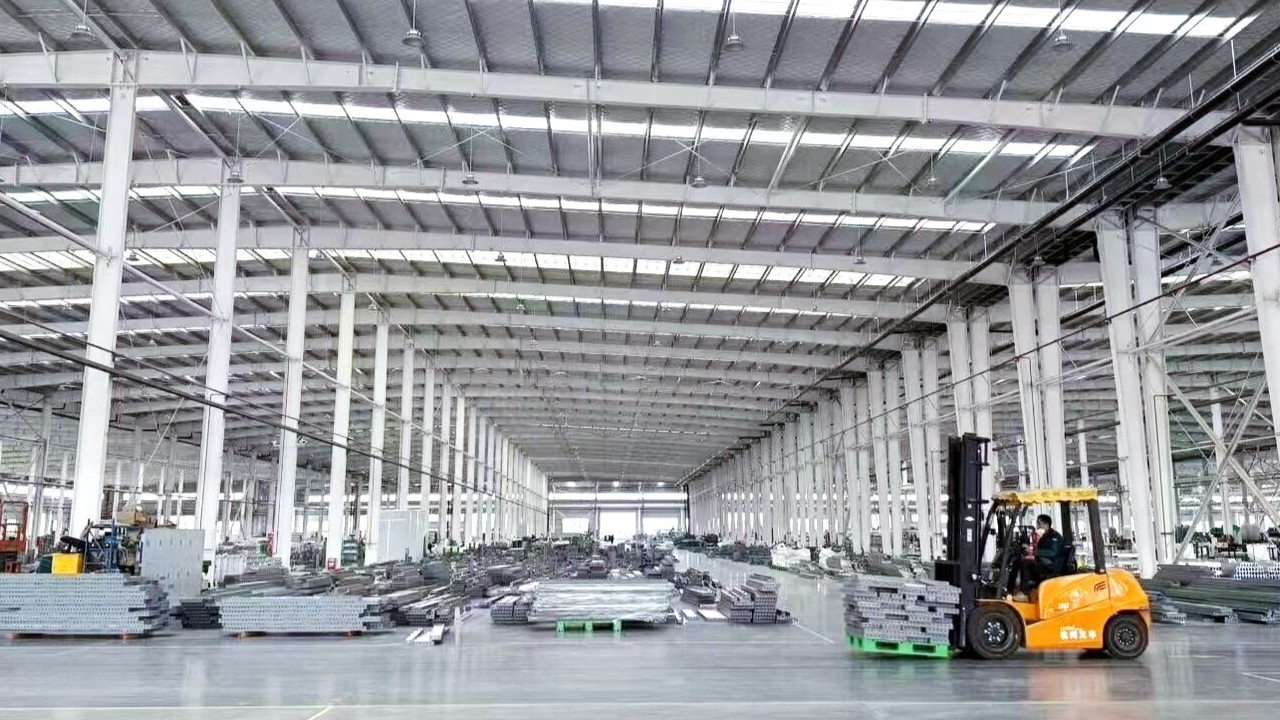
Figure 1 — Production floor at ELPHA's manufacturing base, showing batch production and material handling across the facility. (Source: ELPHA Formwork, 2026.)
02 What manufacturing capability actually means
Capability is not a single figure — it is a combination of production control, engineering depth and execution. Six areas determine whether a manufacturer can carry an overseas project reliably from drawing to delivery.
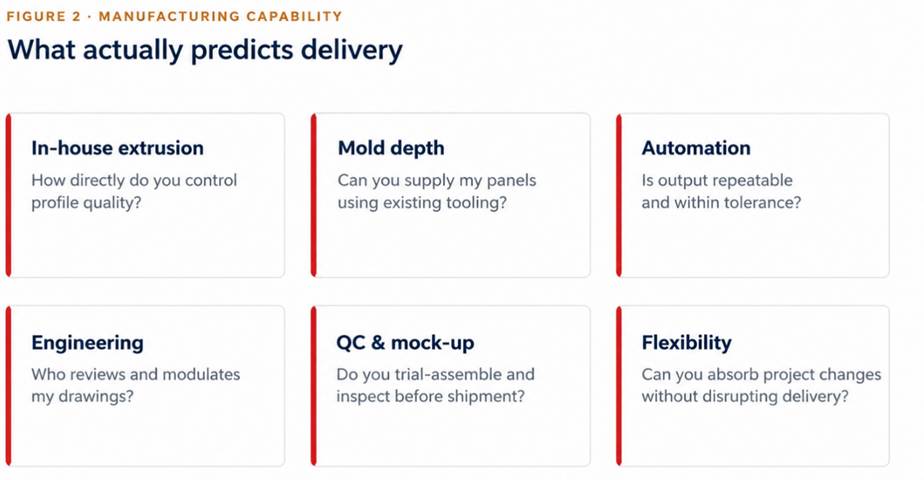
Figure 2 — The manufacturing-capability framework: the questions that predict delivery. (Source: ELPHA Formwork, 2026.)
▪ In-house extrusion — direct control over profile production improves visibility over material quality, production scheduling and consistency.
▪ Mold depth — a broad tooling library reduces dependence on new molds, shortening preparation time and supporting standardized production.
▪ Automation — repeatable fabrication processes reduce panel-to-panel variation and help maintain dimensional consistency at volume.
▪ Engineering — drawings must be reviewed, modulated and converted into a complete, buildable formwork system before production begins.
▪ QC and mock-up — inspection and trial assembly identify dimensional, connection and completeness issues before the system reaches the site.
▪ Flexibility — sufficient manufacturing and engineering resources allow project changes, additional quantities or schedule adjustments to be absorbed with less disruption to ongoing production.
03 Scale matters — but for reliability, not for bragging
Scale is worth discussing, but not as a headline. Its value is what it buys you: redundancy, so your order is not stuck behind a larger one; schedule stability, so a busy month does not slip your delivery; and the capacity to absorb the unexpected — a redesign, an added tower, a tightened deadline — without derailing the work already in the factory.
Scale that does not convert into delivery certainty is just a big number. The useful question is not “how much can you make in a year?”, but “what happens to my schedule when something changes?”
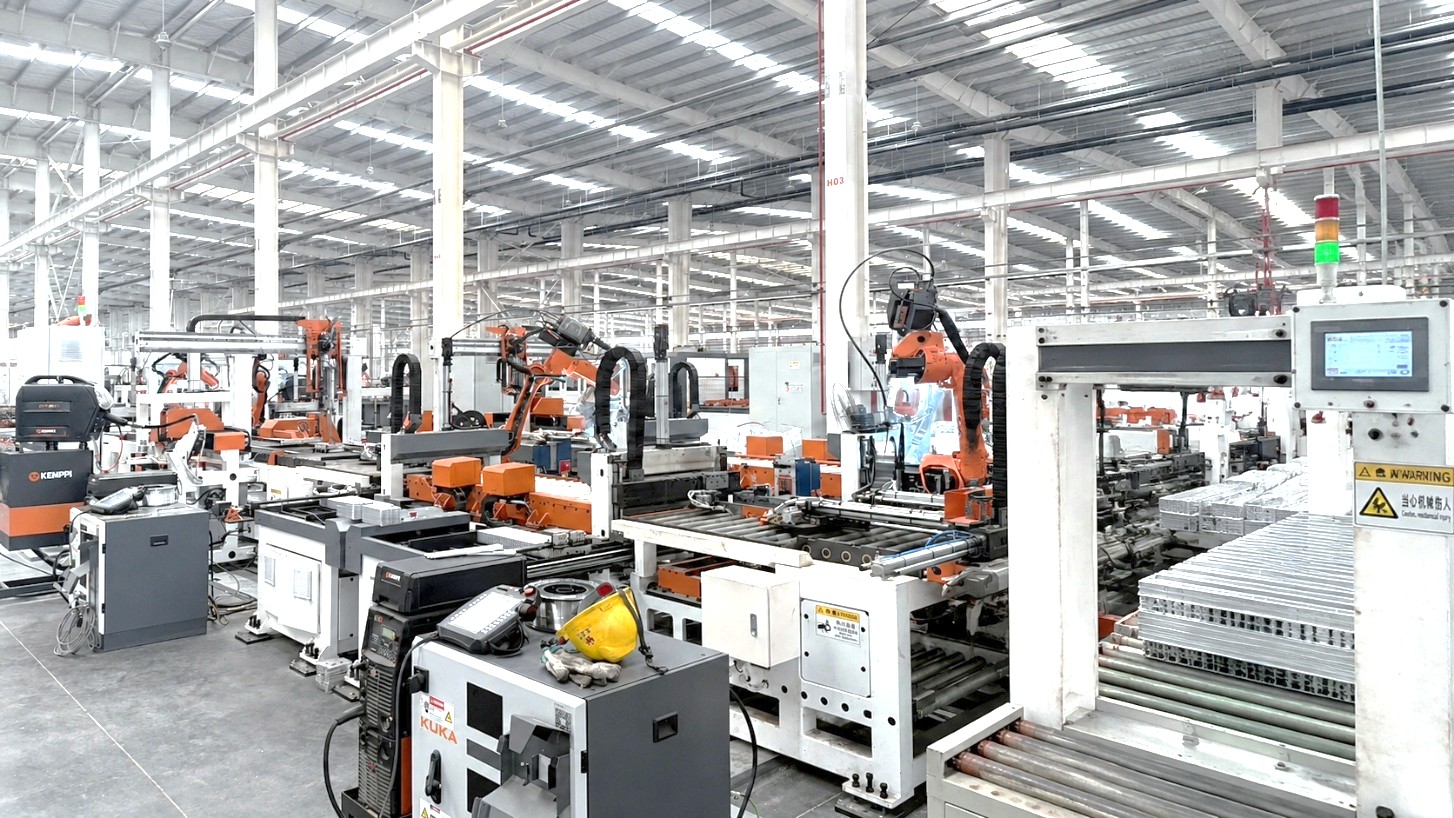
Figure 3 — Automated production infrastructure at ELPHA's manufacturing base, supporting repeatable fabrication at production scale. (Source: ELPHA Formwork, 2026.)
04 The factory is part of your project's risk
Manufacturing errors rarely appear as one major failure. More often, they accumulate through smaller issues — an incorrect accessory count, inconsistent panel numbering, inadequate packing, or a problem that should have been identified during mock-up assembly. Once the system has shipped, each of these minor defects becomes more difficult and expensive to correct.
This makes manufacturing capability part of project risk. Price and annual capacity are easy to compare before an order is placed; execution becomes visible only when drawings change, schedules tighten, or the system reaches site. A reliable manufacturer reduces that exposure by controlling the details before shipment — through engineering review, production control, inspection, mock-up assembly and packing.

05 How to evaluate a manufacturer
A supplier evaluation should go beyond headline capacity and examine how the manufacturer actually controls the project from production through delivery and site support. The questions in Figure 4 focus on the areas where manufacturing capability becomes visible — material control, tooling, production, engineering, pre-shipment verification, schedule resilience and after-sales response.
The objective is not simply to confirm that these capabilities exist, but to understand how they are managed, documented and applied to your project. A capacity figure tells you the size of the operation; the systems behind it determine how reliably that capacity can be delivered.
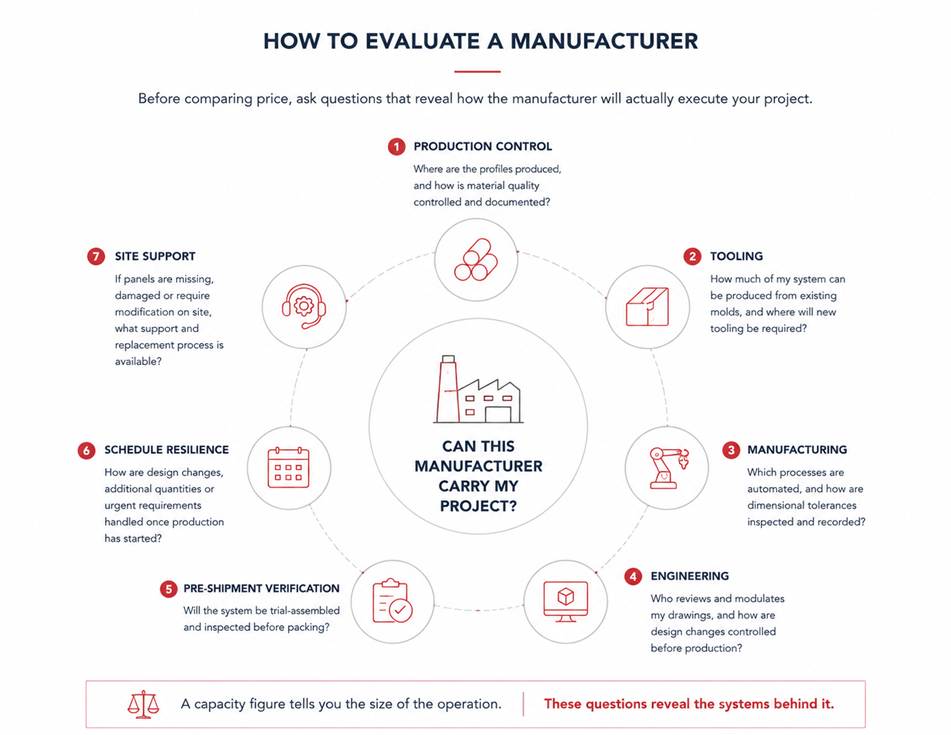
Figure 4 — A practical framework for evaluating manufacturing capability beyond headline capacity.
(Source: ELPHA Formwork, 2026.)
At ELPHA, manufacturing is supported by integrated profile production, engineering before production, automated fabrication, QC and mock-up assembly before shipment, with supply-chain support from XMXYG.
Next step
Comparing suppliers for an overseas project? Send your drawings and schedule, and we will walk you through — capability by capability — how we would carry it from drawing to delivery.

06 Sources and notes
Henan ELPHA Formwork Co., Ltd. (2026). Supplier-evaluation framework, internal engineering, quality-control and verified project records. Unpublished company records.
Henan ELPHA Formwork Co., Ltd. (2026). ELPHA Insight Paper No. 01 — Supply Chain.
Rivankar, H., & Chordiya, A. (2017). Aluminium Formwork Technology. International Journal of Advanced Research in Science, Engineering and Technology, 4(4), 3720–3726. ISSN 2350-0328.
Notes:
Manufacturing-capability criteria presented in this paper are based on ELPHA's internal supplier-evaluation, engineering and quality-control framework. Factory photographs show ELPHA manufacturing facilities in China. Manufacturing capability and project requirements vary by system, project geometry, specification and delivery schedule.